
500 jewellers. One striking pattern.
After years of working with more than 500 jewellers, the same pattern keeps surfacing.
Most owners don't have too little software. They actually have a great deal of it.
A webshop for online sales. A till for the shop floor. A stock management tool. Repair software. Email marketing. Accounting. Online appointments. Customer records.
Each of those is a sensible investment on its own. Every tool solves a specific problem.
But over time, a new problem emerges.
Nobody has the full picture anymore.
What started as digitalisation gradually turns into a patchwork of separate systems, processes and data. And that is precisely where complexity creeps in.
The paradox of modern store automation
Over the past twenty years, retailers have gained access to more technology than ever before.
Yet many owners don't feel any less busy. If anything, plenty of shopkeepers now spend more time on admin, checks and fixing mistakes than they would like.
That sounds contradictory. Automation should save time, after all.
The cause usually lies in how automation is approached.
Many businesses treat automation as the act of adding new software. When a process isn't working, they go looking for another tool to fix it.
But successful store automation isn't about more software.
It's about simpler processes.
Because every new application brings its own data, integrations, workflows and exceptions.
When systems don't work well together, you end up creating more work.
One useful example is the research published in ScienceDirect, which shows that successful digitalisation isn't about isolated tools, but about integrated ecosystems and processes.
Businesses tend to add software step by step. Each decision looks sensible in isolation, but together they often lead to hidden inefficiency and complexity.
Why a webshop isn't automatically an improvement
The webshop is a good example.
Many retailers invest in a webshop because customers increasingly browse, compare and buy online. That's a logical move.
But in practice, a webshop doesn't automatically deliver more calm, more efficiency or more revenue.
That tends to happen when the webshop sits apart from the rest of the business.
Products have to be entered in multiple places. Stock information lags behind. Price changes need updating by hand. Online orders generate extra admin.
What was meant to be an efficient sales channel quietly becomes another process that has to be maintained.
So the most important question isn't:
"Should we launch a webshop?"
But:
"How does this webshop fit our existing processes?"
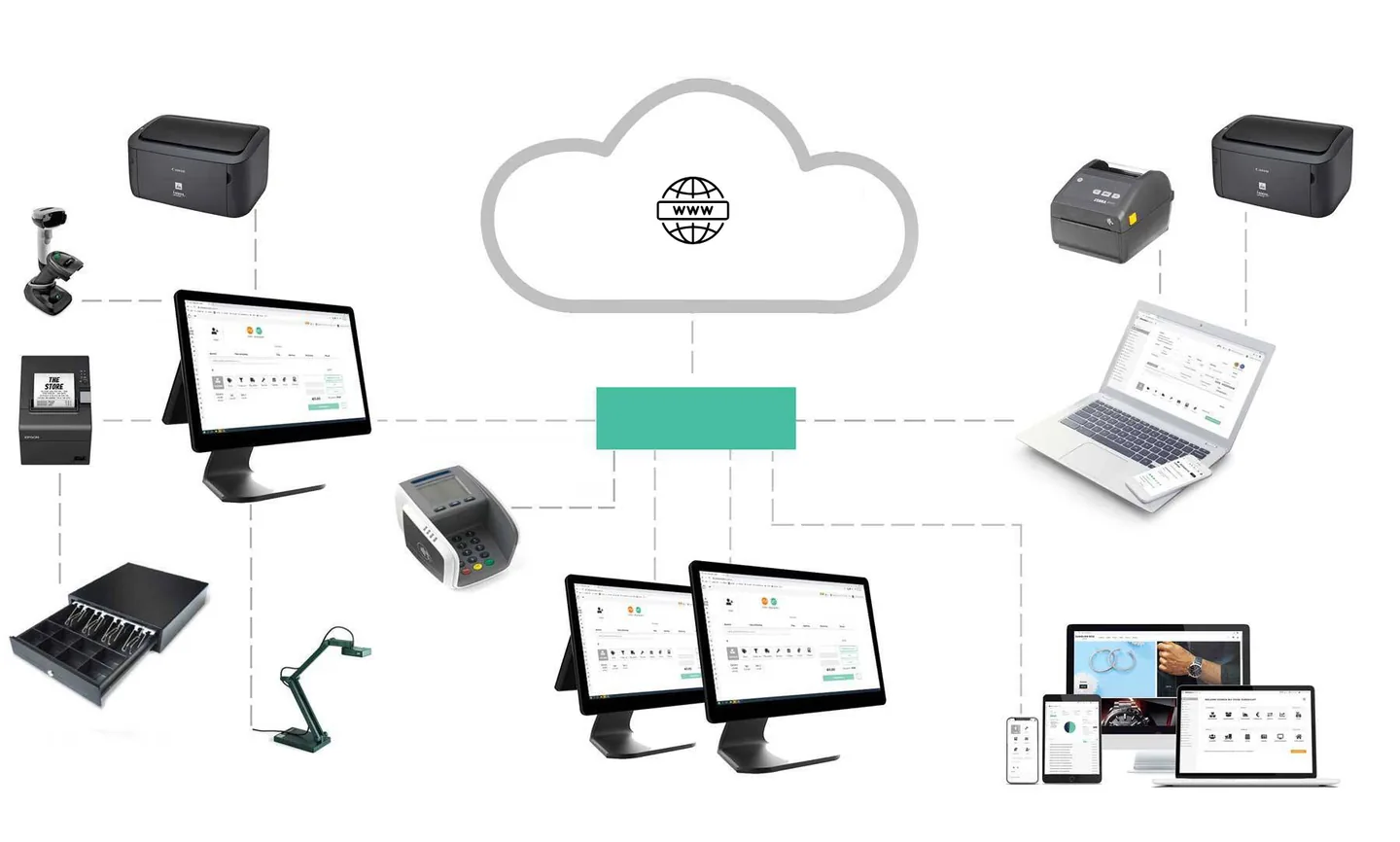
Only when information flows automatically between the webshop, inventory management, till and customer records does the efficiency owners are aiming for actually appear.
The problem is rarely a lack of digitalisation
When processes break down, the assumption is often that another system is missing.
In many cases, the real cause lies elsewhere.
The problem isn't that businesses use too little software. The problem is that the software they already have doesn't work together well.
Each tool solves a specific problem, but together they often create more complexity, less overview and more operational friction.
This phenomenon is increasingly described internationally as tool sprawl: a situation where organisations use so many different systems that processes become fragmented.
Every department works with its own software. Information is scattered across several places. Staff constantly switch between screens and applications.
The result is that the organisation becomes more digital without necessarily becoming more efficient.
More technology then leads not to more overview, but to more complexity.
The hidden costs of disconnected systems
The biggest cost of software is rarely on an invoice.
The hidden costs in retail usually don't sit in weak sales, but in fragmentation between systems, channels and data. Integrated processes matter more than adding yet another tool.
They sit hidden in everyday work.
- A team member who has to hunt down customer information.
- A customer ringing because a status update never arrived.
- A stock discrepancy that has to be checked by hand.
- A repair that needs to be looked up in several systems — the kind of fragmentation we unpack in our guide to optimising the repair process.
- A price change that has to be updated in several places.
Each of these looks like a small task on its own.
But when they happen dozens of times a day, they add up to hours every week.
There's another effect.
Every extra manual step increases the risk of mistakes. And every mistake leads to corrections, customer queries or more internal coordination.
The real cost of fragmented software isn't in licence fees, but in lost time, missed efficiency and avoidable frustration.
Curious what store automation looks like for your shop when everything runs on a single, joined-up system?
Store automation is a strategic choice
Many owners treat automation as a technical project.
In reality, it's a strategic choice.
The central question shouldn't be which software is available.
The central question is how the business wants to work.
Only then does it become clear which technology fits.
Every new investment should support three goals:
- More overview
- More simplicity
- Less manual work
If a solution doesn't support those goals, it usually adds more complexity than value.
Successful retailers therefore don't start with technology.
They start with processes.
They map how information flows through the business, where duplicate work appears and which steps can be automated.
Only then do they choose software that supports that way of working.
The customer journey no longer starts in the shop
A second important shift is that customers increasingly engage with a shop digitally well before they visit.
They discover products on social media.
They browse websites.
They compare retailers.
They read reviews.
They book an appointment online or send an enquiry through a form.
By the time customers actually walk into the shop, they've often had several touchpoints already.
That means store automation is no longer only about internal processes.
Customer communication is now part of the whole picture too.
Think of automatic status updates for repairs, online reservations, appointment requests, product information and customer messages.
Customers expect these processes to be fast, accurate and consistent.
When information is scattered across separate systems, that becomes much harder to deliver.
The future of store automation
There's a growing international consensus that the next step in retail isn't yet more standalone software.
The focus is shifting towards connecting processes, systems and data.
The most successful shops are rarely the ones with the most technology.
They're the shops with the most clarity.
Their information sits in one place.
Their processes join up.
Their staff know exactly where to find what they need.
Their customers get answers faster.
And owners stay in control of the daily operation.
That doesn't only mean more efficient work — it also means better customer experiences and more room to grow.
Conclusion
When we first started working with jewellers, we often expected their biggest challenge to be digitalisation.
In practice, it turned out to be something else.
Most shops already had software.
Sometimes a great deal of software.
The real challenge was overview.
Because the more systems you add, the more likely it becomes that information gets scattered, processes slow down and staff spend more time on admin.
That's why successful store automation isn't about more technology.
It's about simplicity.
About processes that work together.
About information that isn't sitting in five different places.
And about a shop that can grow without the complexity growing with it.
In the end, no owner wants more software.
They want more time for customers.
More grip on their business.
And the calm to focus on what really matters.
This article draws on experience from more than 500 jewellers we work with, combined with insights from international research into retail technology, system fragmentation and store automation.